This episode of Simple Civics: Greenville County is brought to you by Dolly Parton’s Imagination Library, providing free books to children zero to five throughout Greenville County. To sign up, visit greenvillefirststeps.org/freebooks.
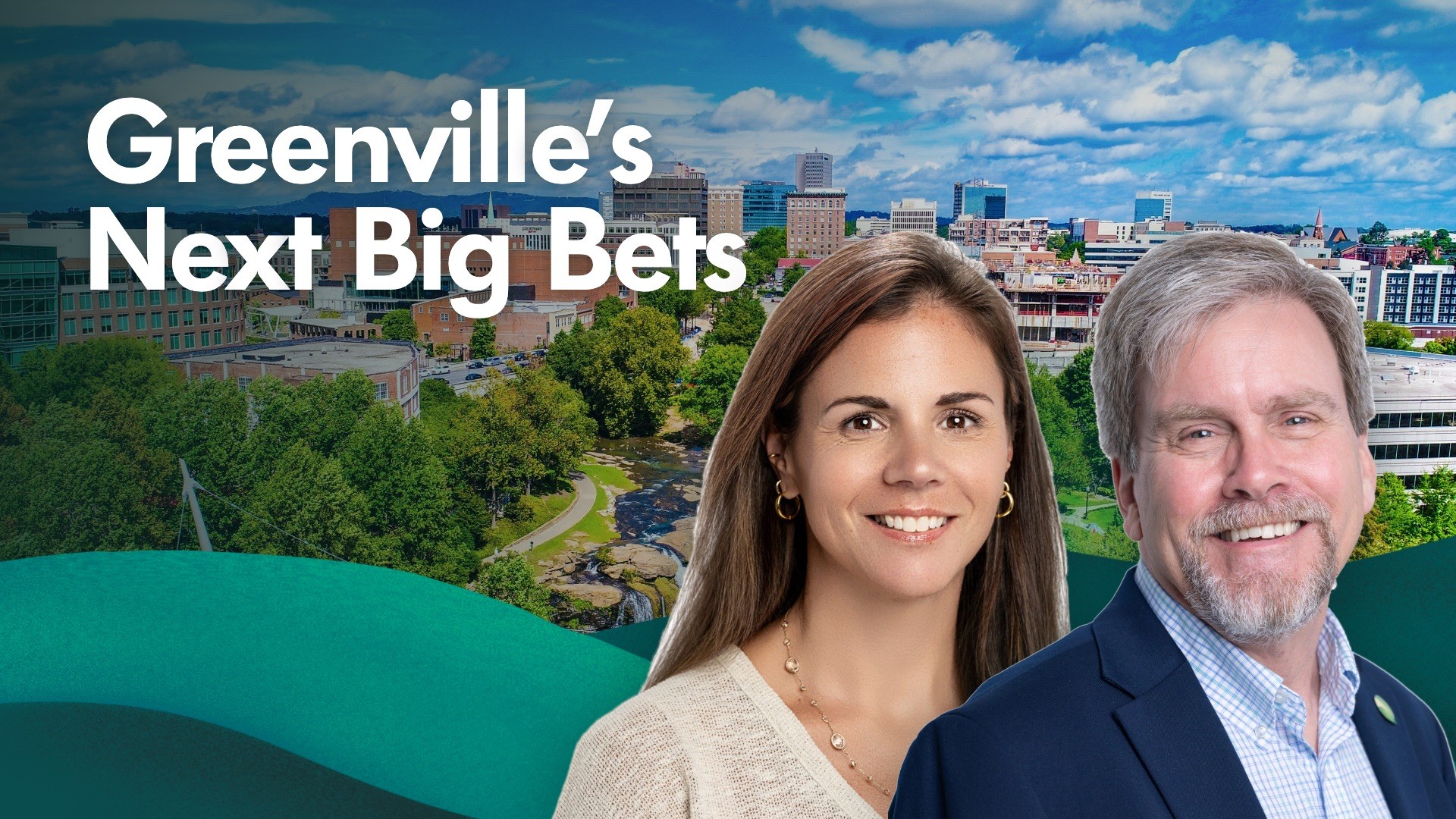
Big bets like the recruitment of Michelin and the BEST school program shaped the Greenville County we know today. What’s next? Derek Lewis talks with the Greenville Chamber's Hank Hyatt, Senior Vice President of Economic Competitiveness, and Brittney Kessler, Director of Economic Competitiveness Initiatives, about their Big Bets series and how housing, child care, and other needs and opportunities are on the minds of business and civic leaders.
Resources:
Greenville's past big bets: Michelin and BEST
Derek Lewis: Thank you guys for joining us today. I really appreciate the time. I'm really excited about these conversations about Big Bets, and it just seems like a very different way to think about how communities can plan for the future. But Hank, I know that there have been big bets in the past, so could we maybe just reflect on like some of the big bets that the Chamber has been a part of before today?
Hank Hyatt: Well, I think Greenville has a long history of making big bets. We've had really good leadership, good vision, consistency, and moving toward great outcomes for the region. And a few of them come to mind. I think one that's really broad, but it's just a transformation of the economy from textiles to advanced manufacturing. And you know the recruitment of Michelin to Greenville was really key in that transformation. I think those were some decisions made by leaders in the community that they had to have some conversations, hard conversations about: we can't continue down this trajectory necessarily, we need to diversify our economy, what do we need to be doing? And so that was, you know, an intentionality about the future.
That's what it's all about. So Michelin is a, you know, a well-known story, I think, in the community. One that has come up lately, which I think is rather interesting, that a lot of people don't know about, but it's impacting us today, is the BEST program, the
Derek Lewis: Yeah. Okay. With the school district, yep.
Hank Hyatt: Right, so Building Equity Sooner for Tomorrow. And back in the nineties, when I first came to Greenville, Greenville had a very crowded school system. You know, we have... you know the numbers better than I do. We are what in terms of the size? So
Derek Lewis: About 45th in the country, the 45th largest district in the country.
Hank Hyatt: Huge district, and we've always been very large. But back then you had almost mushroom-like pods of pods everywhere for school districts of portables, that they alleviated overcrowding with portables and putting students there. And yes, they did have air conditioning, but they were not necessarily the best option, but it served a need. So to get ahead of that, community leaders came together, business leaders came together to figure out: how can we create basically a 20-year building program and condense it down to about five or six years? And that's what BEST was.
Derek Lewis: And Brittney, you lived through the BEST program here at Greenville County Schools, did you?
Hank Hyatt: And.
Brittney Kessler: Yeah, I did. I went to Mauldin High School, and when I started there, I was still in the original school that was built in the seventies. And then my sophomore and junior year, construction was happening. I believe for both of those years, we had to eat lunch in the gym. So that was an adventure. And then my senior year, we were the first class to graduate from the new school. So it was really neat being there, especially now that I know what it was and not just a regular construction project. But we were in portables. I had several of my classes in portables, which made our parking more difficult. We had to park across the street in a cow pasture so that there was room for the portables in the parking lots. But the new school was great, and I think it's still just as beautiful as it was when it was first built.
Derek Lewis: Yeah. I mean, when you think about, like, with the BEST program specifically, that idea of compressing, like, what we really needed to do is renovate or build, you know, 45 new schools all at the same time, and the budget didn't allow for that. And the kind of, to me, the beauty of the BEST program was that these visionaries said, "We will never get the school board member from Fountain Inn to agree to be the 45th school that we built," you know, so we're gonna have to figure out a way to get everyone and everyone's schools taken care of within a very short period of time, which the budget did not allow for.
Hank Hyatt: So someone told me that, I could think, that if they were on the plan to build the one or two schools a year, they would be about halfway through that plan right now, so.
Derek Lewis: We today... Yeah, yes. And can you... I'm just, can you imagine the schools that are still 15 to 20 years from now and being told like, "Well, just hang on, your grandchildren will benefit from this school construction plan that we have." I mean, BEST really in five years really accelerated that stuff.
What makes a big bet
Hank Hyatt: Right. Yep. Yep. So it was innovative, it was daring. We talk about big bets, I think there are three or four things that are important. It has to be audacious, has to be bold. You go out on the edge, so to speak. It has to be a big investment, you know, not a couple million dollars, it's like $30, $40 million, whatever it might be. It has to have a time limit. So a certain length of time, has to have an hypothesis that if you invest this, this positive outcome is going to happen. And then it has to be kind of cross-sectoral, so you have all kinds of people engaged across the community.
And with BEST, one thing the Chamber was involved in, and this was to the best of my recollection, CEPO is a Corporate Partnership for Operational Excellence, which was a group of business leaders helping the school district around operations, maintenance, facilities, food service, transportation, just helping think through business practices to make sure they were fully optimized, let's put it that way. And then at the same time, you had the Alliance for Quality Education getting started around advocacy. And so you had a trifecta, if not more, folks involved working on that issue. So that really was a big bet that's paid off now. So they had 70 schools that were either remodeled or built from the ground up, and we're seeing the benefit of that now 25 years later, so.
Housing and childcare as business issues
Derek Lewis: Yeah. And so now the Chamber's kind of working through those big bets questions of kind of what could we see. Like, what are some examples of things you're hearing as the kind of business community and the elected officials and the nonprofit sector are kind of getting together to talk?
Brittney Kessler: Two things that come up a lot are housing, affordable housing, and childcare, because there's just not enough affordable childcare out there for working families. Even families that can afford it are still on wait lists. I know some friends of mine, as soon as they found out they were pregnant, they called the places they were interested in for childcare and had to be put on a wait list, and by the time it was time for their little one to go, they were not in yet. There's just not enough that are accessible.
Derek Lewis: Yeah, I mean, I think we estimate we need about 4,500 childcare slots right now just to address like the demand in the community, and that is a real challenge. It's been really exciting, I mean, with both housing and childcare are not issues that you would typically expect the Chamber to kind of put a stake in the ground and kind of say this is important to us. But it's really exciting to hear the business community saying many of the same things that maybe the nonprofit sector or the faith community have also been saying.
Hank Hyatt: And I think that business wants Greenville to be the best place it can be for their employees and for their business. And so they're, I think, looking at issues that might be outside their four walls. And so, you know, you look at your employees' quality of life: can they have a good life here in Greenville, can they afford to live here, that sort of thing. I think a lot more employers are thinking about those issues in a broader perspective now. So it's pretty exciting.
Derek Lewis: You know, we in the nonprofit sector are used to strategic planning, and it seems to be kind of on basically a triennial process. Every three years, we're just gonna put out a new three-year strategic plan. But one thing that's been really interesting to me about the Big Bet series is how many different businesses have been coming from the corporate side of the community. Like the nonprofit sector seems really good at talking to itself about the things that the human service sector recognize we need, but we don't often hear from Michelin or from Sobeys or from 3M that these are also our needs. Can we talk a little bit about like how does the Chamber do such a great job at getting the business community to the table to have these kind of, really, what are essentially human services conversations?
Hank Hyatt: I think we're building on what is it, a hundred and thir-
Brittney Kessler: Thirty-seven years. Almost 138.
Hank Hyatt: 138 years of service to the community. There's a history. I haven't been here that long
Derek Lewis: Okay, so there's a history there.
Hank Hyatt: But it's a natural place for business to congregate. Again, in my mind, the Chamber operates at the intersection of business and community. And again, it is where business goes. We can be the convener of business to bring their voices to the table, along with the nonprofits, along with philanthropy, along with government. I mean, all the different partners that have to be at the table to make change happen. And so I think that we are the natural convener in the community for that. So we're standing on the shoulders of giants, you might say, not to be too hyperbolic.
Lessons from the Chamber's Boise trip
Derek Lewis: It does seem like some of this also comes from the trips, right? So kind of the trip to Boise, which was really transformational to me, to be kind of in a different community with business leaders talking about these needs. I mean, can we just talk a little bit about kind of those, I don't...
Brittney Kessler: Yeah, so we took close to 85 people to Boise to learn about their community and learn what we could bring back here. And Hank and I were talking earlier, I think we had maybe a dozen of those were nonprofits, which is unusual for those kind of trips. We made personal asks to those that we thought would be a good connection in Boise, and you know, you're there with these business people for three days and you really get to learn a lot about what they're doing and how they might can help you as a nonprofit. And then with that trip, we came back and thought, let's take a look inwards here at home and see what we need to do here and what kind of big bets we can place here that we talk about in the future.
Derek Lewis: One-on-one conversations in Boise were really, I mean, just invaluable. I mean, it was really incredible to me to be on a bus with someone who runs the Greenville-Spartanburg Airport and talk about a childcare need that, like, I don't think we would have ever been in the same meeting where I ever would have heard him say childcare is a priority for us. I would have assumed the airport has a whole long list of things that they need to work on that don't involve childcare. And so it was immediate though, like, "Here's Micron, Micron has built an on-site childcare center." "I wish we had an on-site childcare center." Just happened on the ride home from the center, so there was just a lot of just opportunities for those conversations that wouldn't normally have happened.
Hank Hyatt: Planned serendipity, maybe, I don't know. No, that's really interesting. And then Micron, I don't know if you saw the news this week, they just announced another large investment in Boise as part of their expansion, because they're huge expansion in Boise. But this is to transit, affordable housing and even childcare savings accounts in Boise. So there are a lot of employers out there that are actually looking to figure out how, as they grow, how they help the community grow and partner and make sure it was a win for everybody. So that was pretty interesting.
Derek Lewis: Yeah. But. Okay.
How nonprofits can connect with business
Brittney Kessler: Just a plug for the Chamber, and a Chamber in... just Chambers in general: part of our job is to make sure that our companies and nonprofits and all these organizations are connecting with the people that they need. That's why we're there. Convening is something that we do really well, and we always tell our members, use us for any connection you may need. If we don't know these people, we'll find a way to connect you somehow.
Derek Lewis: So one of the questions that I've been asked as we've been talking about the Big Bets is, "Wow, these sound like great conversations that the Chamber is having with the business community." There are nonprofits and funders and elected officials all kind of present and part of these conversations. But for people who may not be a member of the Chamber, what advice would you give folks who are in the human services sector about how they could better kind of be a part of maybe engaging with the business community, or how to better engage the community? Going to Boise was transformative, so I mean, I think just being a part of those experiences would be a great example, but.
Brittney Kessler: Yeah. Call the Chamber. I mean, honestly, just, there's about 19 of us on staff, two that are dedicated to helping organizations become a member of the Chamber so that they have access to all of these people and all of these events that we have. We have several events a month; they're all different. There's always networking, though, and the opportunity for those connections. And there are some events that we have for nonmembers as well, so I would just say check our calendar on our website. It's up to date all the time, and even some of our members will post their own events on the calendar, so obviously that'd be a whole different group of people that you would meet there as well.
So really, I think the number one thing would just be to look at our calendar on our website.
Derek Lewis: And it's interesting that you would use like networking, because I think people hear the word networking, they think like, "I sell coffee and I wanna network with you so you'll buy my coffee." But it also means like, "I care about this issue and I want to meet you," so that I can learn that the people who run this restaurant downtown also care about transit, because it's important to them to get their employees to work. And therefore now we have a shared issue that maybe we didn't know about, because I had never asked anybody in the restaurant business, "How do your employees get to work?"
Hank Hyatt: Exactly. I think there's a lot of underlying or undiscovered opportunity out there for folks to engage across, you know, across the aisle of all kinds of aisles in the community, to make Greenville better. So we've got Opportunity Greenville, not to sell again, but we've got Opportunity Greenville, just as a month-long program, four-, five-week program, to help introduce folks to Greenville and the issues and opportunities we're facing. We did a mini Big Bet session with a Opportunity Greenville class with our Economic Development Day and kind of found out what they thought about Greenville. And again, going back to Boise, one thing we found there was they had a strong sense of who they are.
And they said, "This is... you know, we want to protect the front range. We want to do this. We want to do that. We know who we are, and we know we're growing incredibly fast," just like Greenville. So they developed a kind of a plan for where they could go and what they had to do to get there. So I think Big Bet session, inspired by that especially, is that we need to find who Greenville is, what do we value. Like the Opportunity Greenville class, they told us again what they valued, what they didn't value, what they wanted to see changed. And probably 80% of the folks in there were not from Greenville.
So brand new folks to the community. So it's really cool to see. So we want to bring people along into our shared future, in a sense. And that's kind of what we're trying to accomplish with that. For nonprofits, you know, I think businesses are willing to have conversations. I think you gotta talk in their language, whether it's, you know, workforce development, talent, and that's a huge issue for people right now, for businesses.
Derek Lewis: Yeah.
Brittney Kessler: It was five weeks.
Derek Lewis: Okay. Yep, okay.
Hank Hyatt: As we look at housing as infrastructure, childcare as infrastructure, that's infrastructure to get people to be able to participate in the labor force and enjoy the prosperity we've got in Greenville. So that's kind of our view of it. And so, and I think a lot of businesses would, that would resonate with a lot of business. So if, again, restaurateurs we know in town that are very, very familiar investing in housing, transportation for their employees, things like that, these people have a heart for it. And so I think you just gotta find them, ask the questions, and connect, if you're a nonprofit. Mm-hmm.
Next steps for Greenville's Big Bets
Derek Lewis: Well, I just appreciate you guys thinking about the future. I mean, it is really exciting to think about what the next big bet will be, and kind of how the business sector and the government sector and the nonprofit sector kind of all can work together to create whatever the next Michelin or BEST program could be.
Hank Hyatt: Yep. And a big bet doesn't have to be physical. It can be something else. So it's not necessarily a piece of real estate, a brick and mortar. It can be a policy change at the state level, local level, that changes how we develop, that sort of thing. So the next steps for us is we will finalize the Big Bets. They'll be done by November 13. I'm not sure when this will air. Then we'll have a report that comes out that's developed, and we will shop that report out with a number of major CEOs in the region. So we get kind of a grassroots, grass-tops approach to what the big bets will be.
The Chamber may not own the big bet, and maybe, you know, maybe four or five big bets. So we'll see where we land, but this has been a great... I've had a ball this past year working on this. I don't know about you, but
Derek Lewis: Yeah.
Brittney Kessler: Yeah, and our attendees have really appreciated all the conversations, just based on the survey results. They've talked about how they've been in the room with people they may not have ever been in the room with before, and that they just really appreciate the work that we've done and that the speakers have done to bring all this information to light.
Hank Hyatt: We have a lot of strong leaders in the community, a lot of with strong opinions, which is great, but that we appreciate all their engagement, including yourself and folks on housing and other issues and the private sector leaders that have come to speak on those issues. So it's been a fun process. We'll see where we land.
Derek Lewis: Well, thank you guys for your time today and for all that you're doing.
Credits
Simple Civics: Greenville County is produced by Podcast Studio X and is powered by BuzzyPod.
A Greater Good Greenville project.