With 30% of Greenville County's registered voters already voting early, Election Day 2026 sends the rest to their assigned precincts. Katy Smith of Greater Good Greenville and Nathaniel DeSantis cover where to vote, the five accepted photo IDs, what to do if something goes wrong at check-in, poll watchers versus poll observers and why local results take time to become official.
Disclaimer: This episode is for general information only and is not official election guidance. Please check with the South Carolina Election Commission at https://scvotes.gov/ for official details.
Resources:
Greenville County's record early vote
Katy Smith: It's finally here, Election Day 2026. While a massive 30% of Greenville County's registered voters have already cast their ballots during our largest midterm early voting period ever, the majority of our community will be heading to their assigned local precincts today. If you are among the thousands of voters preparing to cast your ballot between 7 a.m. and 7 p.m. today, you might be wondering exactly how the process works on the ground. I'm Katy Smith with Greater Good Greenville, and on this episode of Simple Civics: Greenville County, Nathaniel DeSantis and I will walk you through our early voting data and everything you need to know before you get in line. We cover the accepted forms of photo ID, what to do if you encounter a hiccup at the check-in table, the strict rules for poll observers and watchers and why our local election results will take some time to finalize after the polls close tonight.
Take a quick listen to feel fully prepared and thank you for being an active citizen in our country's civic life.
Nathaniel DeSantis: Welcome back, everyone, to Simple Civics: Greenville County. Nathaniel here with Katy. And today is Tuesday, November 3, 2026, which means, yay, it is Election Day. And if you haven't cast your ballot yet, a reminder, polls are open across South Carolina from 7 a.m. until 7 p.m. tonight. As long as you are in line by 7 p.m., you will be allowed to vote. So if the line's really long and you get there at 7 p.m., chances are you could be voting by 7:30. But all that matters is that you're in line by 7 p.m. And Katy, this is the day our community has been building toward for months with all the signs, all of the episodes we've been doing, but the truth is a massive portion of Greenville County has already had their say.
Katy Smith: Yeah, that's right, Nathaniel. Election Day is really just the finale of this election season now. South Carolina voters turned out in record numbers for early statewide voting period for a midterm, which ran from Monday, November 19 through Halloween on Saturday, October 31. The South Carolina Election Commission reported that over a million ballots were cast across the state before Election Day even got here.
Nathaniel DeSantis: And I'm gonna take a gander and I'm gonna say Greenville led the charge on those numbers, didn't we?
Katy Smith: Yeah, in terms of raw numbers, we did. We led the state in early voting, casting 104,608 ballots, and Charleston County was right behind us with 99,275 early votes, followed by Richland County with 92,575. So we have currently just under 350,000 total registered voters, which means 30% of all registered voters here have already cast their ballots before the polls even opened this morning. But I do have to note that in terms of percentage of voters who voted early, we were in the middle of the pack, with Greenville County at the 24th highest for early voter turnout.
The top of the list in the state was one of our smallest counties, McCormick County, where 43% of their registered voters voted early. And they were followed by Georgetown, Allendale, Richland and Charleston counties. And at the very bottom of the list were Laurens and Chesterfield County. So they have a lot of folks who need to come out today to cast their ballot.
Nathaniel DeSantis: Well, that's very strong civic engagement here in Greenville County. Very encouraged by that, very proud to see that number as well and any impact we might have had on that. But did we see any specific trends in, I guess, where and maybe when people were voting early?
Katy Smith: Yeah. The biggest single day for early voting in Greenville County was Friday, October 30, when just under 11,000 ballots were cast. And I will say I kept seeing a lot of data on Sunday about the polls are closed, record-high votes, but Halloween was an election day, and that was our second-highest day of voting, and that data didn't come in until Monday morning. That day saw 10,417 voters turn out. So before people went out trick-or-treating, they went and cast a ballot. Now, as for locations, the most popular place, which is not surprising, to vote early was McAlister Square, the kind of headquarters for the Election Commission.
But other active early voting centers included Praise Cathedral, Cedar Grove Missionary Baptist, the Greenville County Library at Five Forks and the Greenville Tech Northwest Campus. I know people all have their favorite place to vote depending on where they live, and those were the top ones here in Greenville County.
Finding your polling place and precinct
Nathaniel DeSantis: And things are gonna look a little bit different for the 70% of registered voters heading to the polls today, because unlike early voting, where you can go to any early voting center in the county, today you must go to your specific assigned neighborhood. And I'm gonna quickly plug our Simple Civics candidate look-up tool. If you pull up the look-up tool, you'll enter your address and you'll find the location for where you go to vote. Always double-check with official sources to make sure that that is correct, because we have had situations where things change. So double-check and make sure, but we try to make that really easy. But since we're on that topic, Katy, how are those precincts actually determined?
And how many people vote at a typical polling place?
Katy Smith: Precinct lines are drawn with the help of the South Carolina Office of Revenue and Fiscal Affairs, and they provide technical assistance to the state legislature to draw electoral maps, including precincts, after every decennial census. And we will put a link in the show notes to the precinct map for Greenville County. And of course, in Greenville County, we have varied geography and population density, and so our precinct sizes change. And some of our precincts have grown a lot just since they were last drawn. As you all know, new neighborhoods are being built everywhere. So the biggest precinct in terms of population is Walnut Springs, which is located east of Scuffletown Road, and those folks vote at Rudolph Gordon Elementary School, and they have 5,850 registered voters.
The other four largest are Greenville 24, which is near Haywood and Woodruff Road, and you can imagine that's where Hollingsworth is, so it has grown a lot. We've got Moore Creek south of Log Shoals Road, Mauldin 2 in the Carolina Point area, and Ranch Creek near Standing Springs Road and I-185.
Nathaniel DeSantis: But on the flip side, some polling places serve a very small number of neighbors, correct?
Katy Smith: Yeah, exactly. Our five smallest precincts are Belmont, located on the west side of Conestee Nature Preserve, which has only 853 voters. The other smallest precincts include Greenville 28 off North Pleasantburg, Greenville 6 in the Woodside Mill and Southernside area, Pelham Falls over by Rolling Green Village, and Greenville 27, which includes Timmons Park. So regardless of the size of your precinct, whether you have only 800 voters or almost 6,000, the rules for what happens on Election Day, should you be going to vote today, and I hope you are if you have not already voted, those rules are exactly the same for everybody.
Voter ID, polling place rules and provisional ballots
Nathaniel DeSantis: Yes, rules, very fun. So let's go over those rules to make sure everyone is prepared, because there are few things you gotta keep in mind. So when a voter walks into their polling place today, which I know you're gonna do if you're listening to this, what do you need to have in your hand?
Katy Smith: You need to have a valid photo ID, and under South Carolina law, there are five accepted forms of identification. You can have a South Carolina driver's license, a South Carolina Department of Motor Vehicles ID card, a South Carolina voter registration card that includes a photo, which you would have gotten at the election office, a military ID or a U.S. passport. Another important rule is that you cannot wear paraphernalia from a campaign when you go. So don't wear T-shirts or hats or stickers for your candidates, whoever they are. In fact, we can't even have signs for candidates within a certain number of feet of the polling place, which is why you often see a whole bunch of candidate signs densely packed on the edges of a polling place.
If there's a yard, like, for instance, if you're voting at a school and there's a private residence right next door, they're allowed to have a sign in their yard. But otherwise, it is a campaign-free zone when you get within a certain distance of the election polling place, so that you can go in and make up your own mind and not be swayed by a great logo.
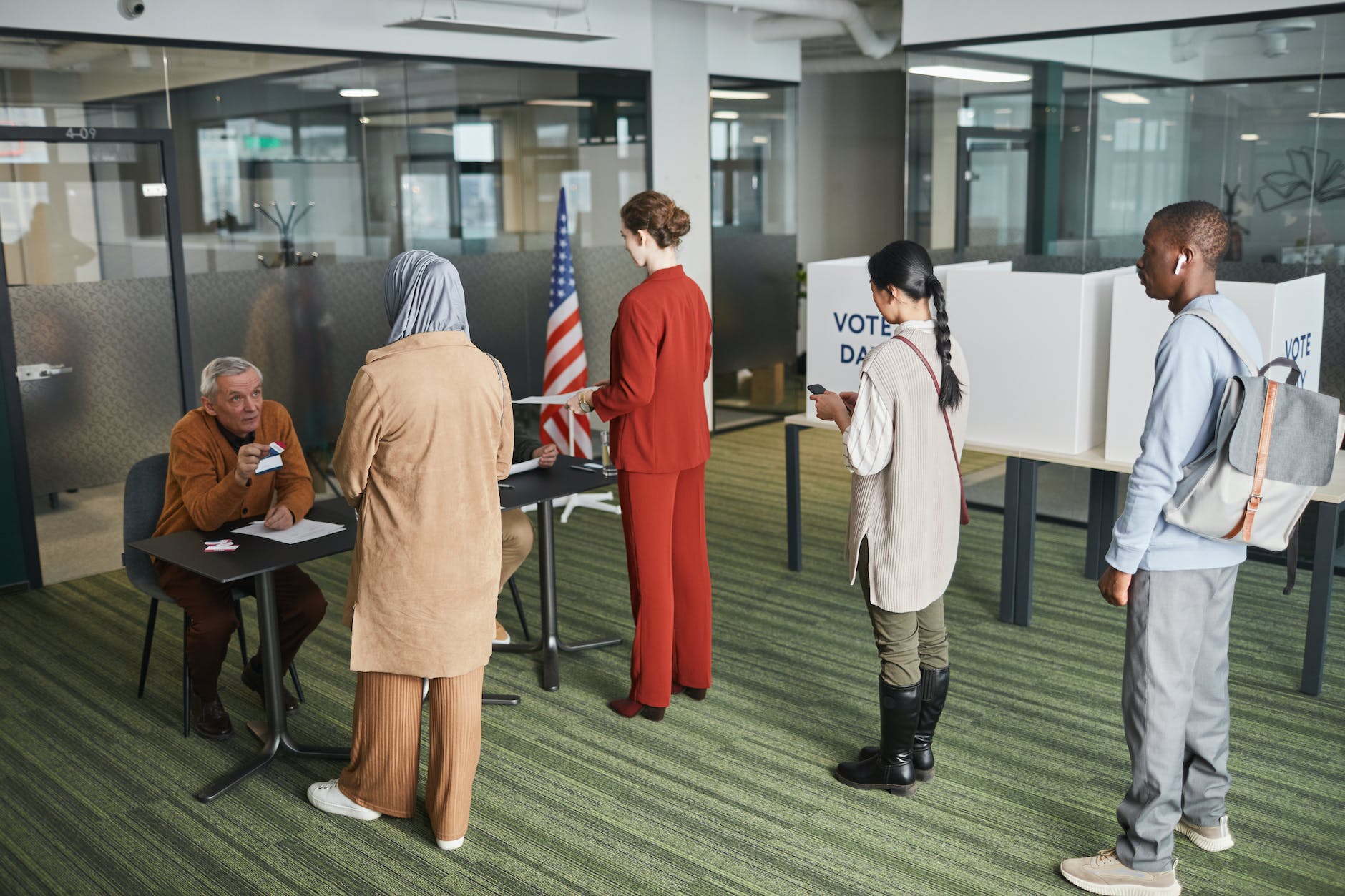
Nathaniel DeSantis: And that is, I mean, that is taken very seriously. I've mentioned so many times on this podcast, I've worked for campaigns, and I remember Election Day, our number-one rule was nowhere near the voting lines, unless you were going to vote, of course, but otherwise don't even get near it. But for the most part, for almost all voters, Election Day goes off without a hitch. It's a pretty straightforward process. You go to your polling place, you present your ID, you confirm your address, you sign the pledge, you get a ballot, you insert it into the machine, then you vote and get your sticker. But sometimes prospective voters will have a hitch in the process, which has actually happened to my dad. So what should they do if that happens?
Katy Smith: Well, first, do not panic. Your elections officials are well trained and well prepared for all the things that may come up. And everyone's main goal is to allow you to cast a ballot. I will say that I have worked the polling places in the past and I am getting to work today. So we recorded this in advance because I'm excited to get to help work elections. And I can tell you, we were all so tremendously well trained and we've got lots of people smarter and more experienced than us to lean on in this process. So things can happen. You forgot your voter ID, you're registered to vote in South Carolina but you've moved, which could be just down the street or within the same county.
You came to the place that you remembered voting the last time, but the folks are telling you that it's now the wrong place. These things can happen and the folks working the election can advise you on what to do. So just to give you a heads-up, they might have you complete what's called a provisional ballot, which is, you're gonna see, it's on paper, you'll seal it in an envelope, and this gives you and election officials a chance to sort things out before the election is certified. So don't stress out if that happens. It's a way to make sure you get to cast your ballot if some of those details are not corrected. Your election officials might have you go to your correct polling place, because locations do change, if you went to the school that you voted at in 2022 and now it's at a church down the road, or they might have you go to the central office to vote.
You might see your election clerk call the central office themselves just to confirm everything's right, because again, you getting to vote is everybody's main goal, as long as you have registered well enough in advance of the election per state law.
Poll workers, poll watchers and poll observers
Nathaniel DeSantis: And I'll also mention that it's a very accessible, friendly process. My dad, to bring him back up, has accessibility issues, and they bring a voting machine to your car if you need it. It's quite incredible to watch, I mean, the steps that we go through in this country to make sure that you can vote. So if that is a concern, they will help you with that and guide you through that as well. But moving on, let's talk about the people managing the logistical effort today, which is really quite incredible. When voters walk in, they interact with poll managers and clerks. We also frequently hear about poll observers or poll watchers.
What is the difference, and how does the environment inside a polling place operate?
Katy Smith: So the environment inside your polling place is highly structured and professional. As I mentioned, the poll workers you will interact with, the managers and the clerks, they are your neighbors who have undergone strict standardized training by the Election Commission. And they're there to do all those things that we've mentioned. Check your ID, make sure you get the correct ballot for the districts you live in, troubleshoot any technical issues. And let me make a quick note right there. Sometimes people get confused about why did my neighbor say they had different people on their ballot than I did. Just because you are all in the same precinct does not mean you are in the same political jurisdictions.
So as a hypothetical, you could be all voting at the same school and feel like you're neighbors, but this person might live in one school district area and you live in a different one. Or there could be a State House district that runs in the middle of that elementary school voting area, which means the ballots that get loaded for you might be different from each other, and that is because you live in different political jurisdictions. That is all taken care of by the Election Commission. So having said that, the folks that are there will have been in place by 6 a.m. at the latest and will stay there probably well past 8 p.m. to get everything closed down.
Now, you may also notice people that seem to be watching what's happening that don't seem to have an official role that interfaces with you in any way. And those may be poll observers or poll watchers. Poll watchers are people who are officially designated by a representative of a political party or candidate. And they come in and they have to wear an identification badge. They have a letter that they've had to present that allows them to be there. And there's a limited number of poll watchers who can be present on Election Day. And then there are also poll observers, which is any ordinary member of the public who has the right to go and watch the democratic process in action. And anyone is able to go and do that, and they're admitted at the discretion of the poll manager based on space, because, of course, the main thing is letting people vote, not having folks there to watch, and we don't need a whole bunch of them there.
In either case, those people are not allowed to have any contact with you as a voter. They can't interfere with the processes in any way. They can't touch anything, no equipment. They aren't interacting with the poll workers or disrupting the operation. They can't take any pictures or anything. They are just there to observe democracy, either on behalf of a candidate or a party or just someone who's curious about it. In all my decades of voting now, I have very seldom seen those folks at the polling place. Occasionally, I have, though, and it's pretty much a non-event. They're just there doing their thing and it's totally fine.
We have done a couple different episodes on the election, so we can put in the show notes one we did recently with Dennis Stone, who's with the Election Commission, who can talk about how that training process and recruitment happens. And then several years ago, we did one with someone from the State Election Commission about what happens on Election Day. That is still very informative. So if you're really curious about that, we've got links in the show notes for you.
Why results take time and when they're official
Nathaniel DeSantis: And again, once 7 p.m. hits and the final voter in line casts their ballot, the polls are officially closed. It's all done. In today's fast-paced environment, people expect to see results scrolling on their television by 7:15, but in Greenville County, getting local results often takes quite a bit of time. Can you explain why that is?
Katy Smith: Sure. It comes down to geography and procedure. Greenville County is a physically large area, as folks who live here know, stretching all the way up from the mountains at the North Carolina border down to rural farmlands in the lower part of the county. And when the polls close at 7 and that last person in line at 7 has voted, the poll managers at the 151 precincts must systematically close out all those voting machines. They print physical result tapes that really look like a big CVS receipt and they tape them to the door or window of the facility so anyone outside can look in and see what happened there that day. They pack up all those materials and then they physically drive those machines and ballots to the central election headquarters at County Square.
If you're a poll manager in northern Greenville County, just the drive down to downtown Greenville can take an hour. Then, once they're there, they have to wait in line to hand over everything securely to county officials who upload that data. So all of that can take a while, and then it all needs to be processed before you get to see it on your TV screen or news website.
Nathaniel DeSantis: So then how do local candidates who are very anxiously waiting at their watch parties get their information before the county officially uploads it to the internet?
Katy Smith: This is one of the most interesting grassroots traditions of our local elections. So by law, as I mentioned, when a polling place closes and the machines are tallied, the poll managers must print out a paper receipt. It is really like a long receipt tape, and it shows all the vote totals for that specific precinct on Election Day, and they tape it to the window or door of the polling place. So candidates or campaign volunteers will literally drive from school to community center to church to school in the dark, shining flashlights on the windows to read those tapes. They'll call it in to someone who's probably got a whiteboard or a flip chart who records what the vote was that day in those precincts.
That's how local campaigns often know they won a county council or state house race hours before the official website updates. It does not include that early vote or absentee vote, but with about 70% of the vote left to come in, and that's assuming everybody votes, it often gives a good indication, if not a clear sign, of what's happened.
Nathaniel DeSantis: Yeah, and I will say so, when I had to do this, I was assigned three polling locations I had to drive to, and it's really fun, because when you go up and you try to count the numbers, there are like 20 other people there doing the same thing from campaigns, but also from official outlets as well who were trying to tally it up ahead of time so they can break the news first before everyone else. And it's a really fun process of seeing that in action and how everyone hustles to those spots to try to count the numbers. But to bring it back in finally, Katy, it is important to remind voters that whatever numbers we see tonight are entirely unofficial.
So when do the results officially become permanent?
Katy Smith: Yeah, I mean, they're not official until the Greenville County Board of Voter Registration and Elections holds a public hearing to process any provisional ballots, to verify the machine counts and to conduct a thorough canvass. And once the county board ensures that every valid vote is accounted for, they officially certify the county results. Following that, the South Carolina State Election Commission meets to certify the statewide results, which happens no later than 10 days after the election. Only after that final certification do the results become official and binding. And I will say that in South Carolina, if the vote comes in with less than a percent dividing the winners, there's an official recount required. So, you know, it ain't over till it's over, as Lenny Kravitz once famously sang.
But we often do know earlier than that because there's a pretty clear percentage difference. But this year, who the heck knows?
Nathaniel DeSantis: And all this is a massive, carefully orchestrated process that's fueled by thousands of local volunteers and election workers. And I don't think that's an exaggeration to say thousands. And a massive thank-you to the thousands of volunteers and election workers, because it's truly an important process to be a part of. So if you haven't voted yet, you have until 7 p.m. tonight. This episode is out at 5 a.m., so you should have plenty of time to go ahead and do that. So grab your ID, look up your polling place at scvotes.gov or using the Simple Civics candidate look-up tool and go make your voice heard.
Katy Smith: Thank you to all of the candidates who participated in our podcast interviews this primary and general election season, and thanks to all of you for listening so closely to make a good decision when you go to the polls, whether you've already voted early or whether you're going today. And if you haven't yet voted, as Nathaniel said earlier, take a look at the candidate look-up tool at simplecivicsgreenvillecounty.org to help you meet your candidates, learn about the one-cent sales tax referendums and make a great decision.
Credits
Simple Civics: Greenville County is produced by Podcast Studio X and is powered by BuzzyPod.
A Greater Good Greenville project.