This episode of Simple Civics: Greenville County is brought to you by Self Help Federal Credit Union, celebrating the spirit of generosity that drives the upstate forward. They believe giving back should be simple and encourage you to visit givegreenville.org to easily discover and support local nonprofits aligned with your passions. From housing and health to veterans, animal welfare, and the arts, turn your generous spirit into direct local impact today at givegreenville.org.
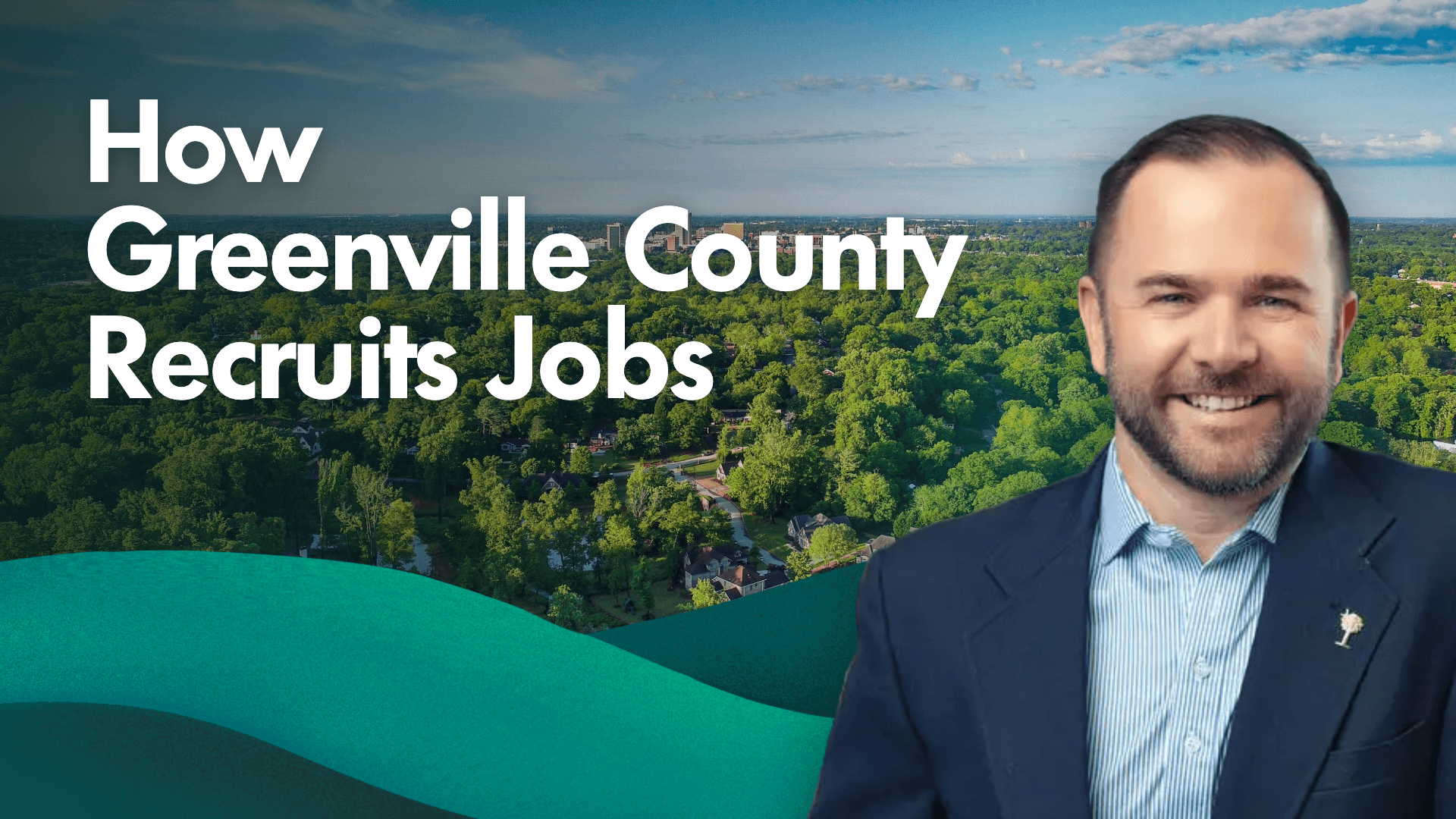
How does Greenville County attract and keep major employers, and what do fee in lieu of tax (FILOT) agreements mean for everyday taxpayers? This episode of Simple Civics: Greenville County breaks down how local economic development works.
Max Stewart is President and CEO of the Greenville Area Development Corporation (GADC), the county's lead economic development organization. He talks with Katy about the agency's work and its newly released 25-year economic impact study.
Max explains why South Carolina taxes manufacturers at 10.5% under its constitution and how a FILOT, approved company by company by County Council, brings that rate in line with neighboring states. He walks through the clawbacks that hold companies to their job and investment promises (only two of more than 200 agreements have failed), the study's finding of $94.2 billion in cumulative impact and about 36,000 direct jobs averaging about $94,000 a year, and why industrial property taxes help fund Greenville County schools. He also shares where GADC is focused next: research and development, corporate offices, and keeping more local graduates in Greenville.
Resources:
How economic development works in Greenville County
Katy Smith: When we hear about a new company bringing hundreds of jobs or investing millions of dollars into Greenville County, it can feel like magic. But behind every major business move is a complex, highly competitive process called economic development. Local communities are constantly competing globally to attract top-tier employers. And one of the biggest tools in that toolkit is a financial mechanism known as a FILOT, or fee in lieu of tax, F-I-L-O-T. How do these tax incentives actually work? Are they fair to everyday taxpayers? And how do we measure whether they are delivering a real return on investment for our community? I'm Katy Smith with Greater Good Greenville, and on this episode of Simple Civics: Greenville County, I sit down with Max Stewart, President and CEO of the Greenville Area Development Corporation.
The GADC is the lead economic development organization for our county, and under Max's leadership, they focus on data-driven strategy to bring high-quality jobs and industry to our region. Today, Max joins me to break down the mechanics of economic development, demystify FILOT agreements, and unpack the findings of their major new impact study, which reveals that GADC's efforts have driven an astounding $94.2 billion in cumulative economic impact in Greenville County over the past 25 years. Take a listen so you can understand the financial strategy behind our growth and see how economic incentives shape the future of our local economy.
Katy Smith: Thanks for being here, Max.
Max Stewart: Happy to be here.
Katy Smith: So to start us off and make sure we're all on the same page, economic development is a term people hear all the time, especially if you're paying attention to local government, but it can sound a little bit abstract. So in plain English, what is the core mission of GADC? And what does doing quote-unquote economic development actually look like on the day-to-day for you?
Max Stewart: Yeah. So economic development is essentially place making. We are making a place where business and people succeed. So that is the core function of economic development. There are many things that go into that, just like every other profession, but our core function is place making. And our role at the GADC in Greenville County is we are the economic development arm for Greenville County. We are a 501(c)(3) nonprofit organization.
So our mission is directly tied to Greenville County Council's function, where they say we want a higher quality of life for every citizen in Greenville County by recruiting and retaining high-wage, high-skilled jobs. So that is the GADC's mission: to recruit, provide a quality of place, recruit high-wage, high-skilled jobs, retain high-wage, high-skilled jobs to Greenville County, and so that people have a better quality of life.
Katy Smith: I love it. It makes it so plain, cuz I will say, sometimes sitting in county council meetings and hearing economic development talked about, it can get a little technical and abstract when you're hearing different agreements read out loud. But to know what it really comes down to: do the people who live here have great jobs accessible to them? Are they making more money? Are all of us thriving because of that? Thank you for making it very specific.
Do new jobs go to local workers?
Katy Smith: You know, I do think people worry that as they look at new companies coming here or new jobs created that they say, oh my gosh, these are all these people that are moving in and making things less affordable for me. Is that a myth? Is that true?
Max Stewart: It is a myth. Most of the jobs, when a company moves to this market, they're looking to recruit the local market, the local workforce. In fact, it's like 85% to 90% of all the jobs created by a company are people that they're finding here in Greenville County or in this Upstate market. There are people that move in, there are people that recruit in from Laurens and Spartanburg and other markets, but it's solidly 85% to 90%. When you start moving a company here, when you're recruiting a new company, there's a couple of years when they're going to have some leadership come to the market to kind of work.
But then they're going to probably go away and do other things, and they're going to hire locally for those jobs. So yeah, it's really a lot of retention, and companies see Greenville County as a place to do business and a workforce that they can support and work with.
Katy Smith: Wow. That's a staggeringly high percentage.
Max Stewart: We actually had a company talk about that a few weeks ago. They said they were asked that specific question: How many people are you going to hire? It's about 90% from the local market. We got to bring a couple of people in from out of the market to train them how we do our job, but that's pretty much what the numbers are.
What an economic developer does day to day
Katy Smith: Amazing. Yeah, all right, well, what does economic development look like then? What does the work of doing this mean?
Max Stewart: It is a very interesting job. It's a job that I don't think anybody goes to college and says, you know, I want to be an economic developer when I graduate college. It's a very different, multifaceted job every single day. You're kind of a Swiss Army knife type person. One day you're working on a rezoning issue. The next day you're working on a water quality issue. The next day you're working with transportation. You're working on many, many different things. So there's not this one focus. The focus is the entirety of where you're serving. And we just happen to be serving Greenville County, all 765, 790 square miles of the whole county.
We're in charge of trying to make sure that everything works for people and for businesses. And so really our day can start with, one day we could be on a site visit with a company touring multiple industrial buildings. The next day we could be preparing for a county council meeting for a set of either incentives to be approved or agreements to be approved by the county council, the finance committee, but then the following day we could be working with companies on roundtables on childcare. So it's everything you can possibly think of that affects the human and the business.
What a fee in lieu of tax (FILOT) is
Katy Smith: One of the most critical and sometimes misunderstood tools in your toolkit is a FILOT, or a fee in lieu of tax. And so for a neighbor who wonders why a major corporation isn't paying standard property taxes, can you explain what a FILOT actually is, how it works legally, and why we use this in South Carolina to stay competitive?
Max Stewart: Yes. So the answer to the question is yes, they are paying the property tax. So it really goes back in the history of South Carolina, and we could get into historical context to this, but really when the state of South Carolina was founded, there was a law that said we don't want the agrarian businesses to be overtaken by the industrial businesses. So to that point, we're going to actually charge them a higher rate than everybody else for their buildings. So a manufacturer would pay 10.5% ad valorem, where a normal commercial general store would pay 6%. Well, that has never changed, because it's very hard to change your constitution when you get through it. So over the years, it's ebbed and flowed, and we've had a lot of different iterations. And they had a couple legislative rules that have come into place where they said we need to be competitive with other states. There is no way we are going to get manufacturing jobs. And we realized the agrarian jobs were, for the most part, en masse going away. We're never going to get those jobs if these companies are having to pay exorbitant rates of tax compared to our neighboring states. So if you were to compare us to Georgia or North Carolina, they're paying in the 5.5% to 6.5% range.
So how do we do that, but also, you know, abide by the state constitution? Well, they came up with the fee in lieu of tax, which is a fee in lieu of your tax. And that is set at around 6%, and it can go up from there a little bit depending on the project. And we have full range to work on projects and negotiate them how we see fit. County Council gives us a table of parameters to negotiate those, but it sets about 6% so that we're equal with everybody around us. So that our playing field is equal. So it's really, it's not an incentive. It's just equaling the playing field between states. We have that in our toolkit. So a fee in lieu of tax is essentially making property tax the same as everybody around us. There's no "you get this, we're going to give you a lot of these different things." And I know we'll probably talk about clawbacks and things, but really it's just setting the bar equally to everybody else.
Then we have an ability on top of that to provide credits for infrastructure purposes to a company. So we offset some of their infrastructure needs. But those are pretty much how we do things. So in South Carolina, that tool seems like it's this big incentive process, when really that is just helping the company, and you can't just broadly do it and say the entire county is under this. You have to do it company by company. And that is the rules, because they are performance-based. And you have to have it performance-based, and so it has to go before the council, and it has to go through readings, and so the public hears about it, and that's why people talk about it.
And that is our biggest tool to stay competitive with our other states.
Katy Smith: So really, any tax is just a way government gets revenue. It's a mechanism. So this is a slightly different mechanism, but tied to it is returns in a specific way for residents.
Keeping existing companies in Greenville County
Katy Smith: Okay, I love it. So clearly we are a competitive place that folks want to come. They want to bring new jobs and new companies here. We have some great long-time companies that are here. What is the GADC's role in keeping them?
Max Stewart: It's the same as when you're trying to recruit a company. These are nationally known companies. And so they have the opportunity to go to other markets around the country. And so our role is to make sure that we are retaining our companies and also recruiting new companies. Now the great thing about it is the retention factor. A lot of our local companies are the ones that are expanding at this point. So we have about a 60-40 split. 60% of the local companies are the ones coming to us with expansions, and about 40% are new. When you have an existing company that's expanding in the market, that tells you that the economy is healthy.
If you're having to recruit new businesses all the time, it tells you that your economy, something's happening. But it's steadily the existing industry that keeps coming to say, we're expanding, but we now have to choose between three of our sites. Where is it going to be? And we're hoping it's in Greenville, and it happens quite a bit more often than usual it's in Greenville County, but that's where we do a lot of our focus, is about 60% retention and about 40% expansion.
Max Stewart: They have to make a business decision. And so we are there meeting with them, talking about the market, what can we do to support them, and they're going back to their leadership and saying, we're getting a lot of support in Greenville. And their leadership goes, okay, let's do it there.
How clawbacks keep incentives accountable
Katy Smith: Then let's talk about some of those returns that residents can get. How do you ensure that companies keep their promises, and what might some of those promises be? Like, if a company receives a FILOT or other incentives based on a promise of, say, 200 jobs and $50 million in investment, what are those legal guardrails that are present?
Max Stewart: Yes. So I think the general public might be surprised that there's a lot of guardrails with projects, from the state to the local level. Everything is performance-based. So the one thing people say, you were just giving them money. We're never giving a company money. We have a clawback feature that says if they don't do what they're supposed to do by the time their investment window ends, we can claw back some of their incentives, both local and state level. But we have a very tight coordination with the State Department of Revenue and the State Department of Commerce with projects. So at the end of the year, I say this is funny because every January, around my birthday in January, we have this meeting with the state and the local auditor's office and the property appraiser's office. And we go through every incentive that happened that last year, and does that company get to keep their incentive. And of the 200-some agreements that we passed, just two have not kept their agreement.
And that's because business cycles, things change and they can't keep their agreement. So of those 200-plus agreements, only two have ever really failed, but they clawed back a lot of their job credits from the state level, and then also the property tax went away on the property. So they cannot get a FILOT for that company any longer in South Carolina. So we keep close watch on that throughout the year. We talk to companies every single day. I have an existing industry manager that, her only job is to meet with existing industry in Greenville to see the pulse of what's going on. If you were to ask me the question, what is your biggest fear every morning waking up, it's reading the WARN reports to see if there's a company that's lost jobs or something like that.
So we're watching this very carefully. That's the first thing I look at. People are like, oh, you look at Facebook. I'm literally looking at the WARN reports from yesterday. That's the geeky thing about our job. But we're really trying to focus on making sure that these companies keep their promise, and they want to keep their promise because they want to keep that incentive in place.
Katy Smith: And you want them to keep their promise because the promise enables something for all of us who live here. It's a new job, it's a better wage, it's a higher credential, whatever it may be.
Max Stewart: And it keeps growing every single year. The average wage keeps going up and up and up for the county, which is a good thing because that ensures we have higher quality jobs in the market.
Katy Smith: Which I could imagine why you're interested in things like childcare, because a good childcare system, which may not in and of itself be economic development, does things like enable someone to fulfill that job promise.
Max Stewart: To go to work. Yep. There's so many employers that we talk to that say they would love to hire more people, but the problem is childcare in the market. I mean, there's many things that were always challenges in the market, but one of the main things is having adequate childcare and safe childcare.
GADC's $94.2 billion economic impact study
Katy Smith: Yes, yes, for sure. Well, in additional good news, you all recently released a major economic impact study highlighting a cumulative, astonishing impact of $94.2 billion on Greenville County over the last 25 years. What were some of the most important takeaways from the study? And I'd love to hear you talk about how the high-level dollar figure translates into benefits for people just like me living here.
Max Stewart: Yes. So we had the study done by Dr. Joey Von Nessen at USC's Darla Moore School of Business. We were going back and looking at the impact for the last 25 years, the impact each year. And as you would have guessed, every single year that impact grows, but the cumulative effort over the last 25 years has been about $94.5 billion of economic investment in this community. And what that means, there's three key points that we talk to everybody about, at least one of the things I talk to people about. Number one is that represents 17% of the county's employment base. So 17%, almost one in every five people works on a project that GADC negotiated, the county approved, for a project in Greenville County in the last 25 years. So that's not even, by the way, talking about the Michelins of the day, the GE Vernovas, original. So these are just in the last 25 years of our history. 22% of the GDP for Greenville County. So it is by far an economic driver in the area. And because the wages that we are requiring companies to keep at the state level, so we don't keep the wages local, but the wages that are required is at the state level, and we're very specific and we're very targeted about who we approach, you see an overall impact.
It's almost two to one to the average wage. It's like $94,000 cumulative average for these jobs. So directly related to the projects is about 36,000 jobs in Greenville County. Now there are about 210,000 jobs, so it's not all the jobs in Greenville County, but it is a very good proportion of it. But if you're averaging those jobs to about $94,000 a year, that is almost 100% above the average wage of Greenville County. So it's a big number.
Katy Smith: Amazing. That's a big number, yeah.
Max Stewart: I can't take credit for all those jobs, but the thing that our council and our organization has been very prudent with is making sure that we're looking at those high-skill, high-wage jobs. It's not about just distribution jobs. We only do industrial jobs. We don't do your commercial jobs, like your fast food restaurants. Those are indirect jobs in the community, or induced jobs. So we're talking about the main focus jobs, which is about 36,000 jobs.
From textiles to F-16s: Greenville's manufacturing workforce
Katy Smith: Well, I appreciate you saying that you didn't have direct responsibility for those last 25 years, but what I think is really neat is that you're fairly new in your seat. We're recording this right as we're about to have some new county council members come on. And to know that you have that kind of wind in your sails, we know how to do this here, we do it well, it's so much success for everyone to build on. That must feel really exciting to you.
Max Stewart: It's pretty exciting. It also shows you where we have come from in the last 50 years. I love history, and if you look at the history from like the '60s and '70s, when we were really textile-focused, to now we are developing some of the most complex machines on the face of the earth here in Greenville County.
So I mean, if you look at it, the advancements that have happened over the last 50 years, you've gone from woven textiles to now literally making BMWs, Michelin tires and F-16s in this market. And just rolling off the line in the next couple of weeks will be Isuzu commercial vehicles. So you're making very, very complex machines in this market. And so what is so important, and I think people will take for granted, is the work ethic and the workforce in this region and in Greenville County. People here are so dedicated to working a job, the dedication in both their voice and also their personal history, three generations working for Michelin, two generations working for Lockheed.
These people have been in manufacturing for a while, and they're really good at it, too. And that shows in our economy. So it's really, every day I walk into the manufacturers and look up like, you guys are next-level committed to what you're doing. And it's awesome. It's really awesome. I say this because we had a site visit with a really respected company that does site consulting work, and they toured CMI, and they met with the instructor, and the instructor was like, I do this part-time. I do this on my own time, and my job, they let him do this because it helps them recruit people too, but he goes, I do this because I'm passionate about the next generation and making them interested in manufacturing.
And I'm like, well, you should have your own TV... I like that, but these guys are really, they're very passionate about what they do. And it gives you a lot of pride to see, because you can show this community off to people and be like, look at this place. So it's really nice. So CMI is the Center for Manufacturing Innovation at Greenville Tech, their campus right off of 85, right next to Clemson's CU-ICAR.
How the job multiplier ripples through the economy
Katy Smith: In this market. It's amazing. I completely agree. When the GADC helps bring a major facility to Greenville County, that impact does not stop at the front gate of that company. Can you talk about how economic multiplier effects work, and how a single new corporate project benefits local suppliers, small business owners, school districts and so many others?
Max Stewart: Yeah. So when a company comes here, we measure both the direct jobs that the company brings to this community, or hires. Majority of the time it's hires from this local community. But there's also the indirect jobs and the induced jobs. So your indirect jobs are those jobs like the grocery store person, the guy who cleans clothes, the flower shop person, the local marketing agency. All those jobs are the indirect jobs. The induced jobs are the suppliers and the networks that have to be around here to support those facilities. So when you talk about a company, a great example is Michelin. If you have a Michelin unit here, they have supplier networks that are around the market that are manufacturing parts for them. Isuzu, same way.
They're manufacturing parts for Isuzu. They are the induced jobs. They have to be here to support that manufacturer. The indirect jobs are the jobs that we see in the community as a whole. Well, for every job created, and this is a national statistic, it's about 2.1 jobs created elsewhere in the local economy. So those are indirect or induced jobs. Well, in automotive and aerospace, the number is higher, and it's like 2.4, 2.5%. So two and a half jobs are created, essentially 2.4, 2.5%, in the automotive sector and the aerospace sector to support those types of companies. And that is exactly where the target sectors for Greenville County are. We talk about mobility, automotive, aerospace and defense. Those are the two biggest sectors we have right now, because Michelin and Isuzu and Lockheed are here. And also complementary components to that, GE Vernova, who also makes turbines. So there's a lot of those aviation, aerospace complementary components here. So you see about a 2.4%. It's the highest in the country. It's the highest markets in the country. So other industry sectors, you might see in the ones, but automotive and aerospace sit at between two and a half percent multiplier jobs.
Sorry, 2.5% multipliers on the jobs.
Why industry pays for Greenville County schools
Katy Smith: Why would it matter to the everyday taxpayer? Why is it important in that sense?
Max Stewart: Well, two reasons. One is industrial and commercial operations. They pay for our schools in Greenville County and throughout the state. The homeowner, the single-family homestead-exempt homeowner does not pay for anything that the school operating, for schools and public schools. That is all covered under industrial and commercial uses and secondary properties. We pay for just the service of the debt for the capital, for the buildings. So to pay your teachers and your bus drivers and all those different things, that's paid by an industrial and commercial property tax in Greenville. And the cost of services. So when you look at also the cost of services for industrial versus a homeowner, the Urban Land Institute commissioned a study, and this is kind of a regional look, so it's not exactly on Greenville, but the cost to serve a residential home: for every dollar that the residential home puts in, it costs $1.30 in services.
And you think of everything that goes into that: libraries, parks, you think of all the different services that they need for a home. Yeah, fire, EMS, at a scale that they need it. But for every dollar that an industrial user puts into the property tax base, they only take 30 cents. So there's a very large gap that industry and commercial property fill within any market, and especially as it relates to South Carolina and especially to Greenville County. So that is why we recruit and work with industrial users, is because they pay for the majority of the tax base for everything that we see within the educational system, for the majority, and also in the public service sector.
They give way more than they take.
Building the workforce from elementary school to Greenville Tech
Katy Smith: Interesting. And I always love seeing all the connections then to help create the workforce that will fill those jobs at places like Greenville Tech or at Clemson. Talk a little bit about those ripple effects then.
Max Stewart: It is a collaborative effort. We are not starting at the high school level anymore. We're all the way down to elementary school. And companies are getting involved in the elementary school level. So you're seeing an education ecosystem that has kind of got its arms wrapped around it by the industry, supporting kids as young as elementary school to talk about the manufacturing opportunities in the future, with kids going to Greenville Tech in their junior, senior years of high school. Greenville County Public Schools has the Grad Plus program, where you graduate plus a certificate in something. And I hope kids or parents that listen to this, hope they get their kids in the mechatronics program, because we're gonna need a lot of mechatronics students in the future.
But I think that is where we see the benefit, is getting them there. And then you graduate from Greenville Tech with a two-year degree, or a four-year degree now, in advanced production technologies, you can go into a job and work a job at 18, 19 years old and be making $50,000, $60,000 a year with a certificate. And then have your employer pay for you to go back to school, to go to Clemson or USC or wherever you want to go to school. The opportunities in this market for collaboration do not exist in other places. And I hope people, because the good thing for me is I come from the outside.
I come from a different state where the collaboration efforts weren't as good as this market. And the market here, really, industry wraps its arms around education, and education embraces industry. You see the signs everywhere. If you go to Fountain Inn High School, you'll see all the companies that are in the Fountain Inn area on their advanced materials program. You'll see it at the CTE Innovation Center. You'll see it in CMI at the Center for Innovation. You'll see all the company signs on the walls. They really engage with the... we wish they'd even engage more, but a lot of those companies engage in that market.
Katy Smith: It is amazing. Yeah, my children grew up in Greenville County schools, and seeing folks who took time off from Michelin, from GE, from BMW to come and volunteer in the classroom to help. It adds so much to students' experience, even if they don't go on to a technical career. But I know a lot of kids who did choose that path because of the influence of those folks.
Max Stewart: When we talk to companies, the thing, and I've said this before, is talent is location. Talent is the location now. You can have a site, you can rebuild a site, you can do things with the site, but if you don't have the workforce and the talent, you're not going to succeed. And that is the main factor for a company when they move here. They can build a building, those things, but do they have the talent to keep operating those buildings, do they have the talent to keep operating the equipment in those buildings? So that's something we talk about all the time, is talent is location. If we are not embracing the talent, if we're not upskilling that talent, if we're not growing that talent, we're not going to continue to succeed like we did in the past.
What GADC is recruiting next: R&D and corporate jobs
Katy Smith: Great. So as we continue to grow and grow rapidly, economic development strategy, I assume, has to evolve with those changes. So as you look at the next decade, what specific industries or high-value sectors is GADC actively working to recruit? And what makes us uniquely positioned to win those deals?
Max Stewart: We are currently in a strategic plan that we started about five years ago, and we're actually working on our next strategic plan, which we'll release in May of 2027. That's a teaser. But we are very focused on what are the next types of metals that are being made? What are the next types of technology that's in the market? We see the benefits of knowing that GE Vernova has a six-year backlog of turbines for the gas industry. There are F-16s to be made until 2031. So you've seen a lot of these parts and components in this market grow and continue to grow. But the one thing that we really are starting to focus on is, we did a study a year ago for a project, a first destination study from the university level.
And only 58% of our graduates are actually staying in this market. So what happened to the other 42%? Where did they go? Well, they went to, obviously, Tesla, Rivian, SpaceX, all those companies that don't live in this market. So how do we recruit companies that would be exciting for those kids to work for? How do we recruit the corporate side for the companies and the manufacturers that are already here in this market? There are over 580 manufacturers that we know of, and there's more, that have corporate operations in other parts of the country. How do we recruit those companies to stay here, because they need back office jobs in this market?
We'd love to have the back office jobs, the research and development opportunities in this market. So that's what we're actively working on. We know we have one asset that we're kind of lacking in, or it's going to be lacking here in the near future, is land to do mega. We are not going to be doing mega site projects in Greenville County, but we are going to be able to recruit those R&D facilities. R&D looks so different now than it used to. If you look at the video clips on YouTube of companies like Anduril and SpaceX, they're in a warehouse. It's like a 60,000-square-foot warehouse with a thousand computers running, looking at one robot in the middle of the floor.
That is the R&D of the future. And how do we get a chance to play in that in Greenville County? Well, we have things that they want. We have quality of life, we have access to talent, and we have access to the transportation networks that they need. They're right in the middle of two major metropolitan areas, between Charlotte and Atlanta. So you have access to all those resources in that area. So that is what our recruitment looks like. We're still going to be working in manufacturing. Manufacturing is going to be the heartbeat of what keeps our economy from facing any severe downturns or really severe upturns either way. We're going to stay on a steady growth as long as we have manufacturing and start adding on the components of the back office for professional technical services, research and development opportunities.
Katy Smith: Outstanding. Well, Max, I am grateful to you and your team for making place here in Greenville County. It is a great place to live, it's a great place to raise kids, and wonderfully a great place for people to be successful in their careers. So thanks for making jobs for them.
Max Stewart: Thanks for having me.
Credits
Simple Civics: Greenville County is produced by Podcast Studio X and is powered by BuzzyPod.
A Greater Good Greenville project.